Leonard
The Cabin at the End of the WorldLeonard is the principal messenger of the visitors’ sacrificial demand: he tells Andrew, Eric, and Wen that one of them must be killed to prevent the apocalypse. He presents the demand as a divine test and presses the family to choose, yet his own wavering belief and final attempt to help them escape expose a conflict between the role he serves and the people caught in its path.
Identity and First Contact
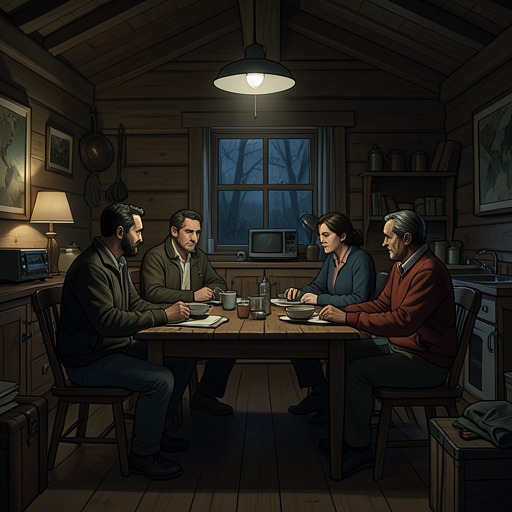
Leonard first approaches Wen while she is outside the cabin. Although his voice sounds much younger than his large frame suggests, he introduces himself without ceremony and asks whether he may speak with her before approaching her parents. Wen does not give him her name, but Leonard addresses her by it and asks her to talk with him. His request is gentle in form, and he explicitly says he also intends to speak with her parents; this opening makes a personal connection with the child before the family understands why he has come.
When Wen hears footsteps approaching, Leonard tells her that more people are coming. He calls her his friend and says he will not lie about the newcomers, while admitting that he does not know them well enough to call them friends himself. He describes their shared task as the most important in history. The assurance is intimate, but what follows puts Wen under an enormous burden: Leonard insists she listen before going inside, and later explains that the fate of the world depends on her family.
The Sacrificial Mandate
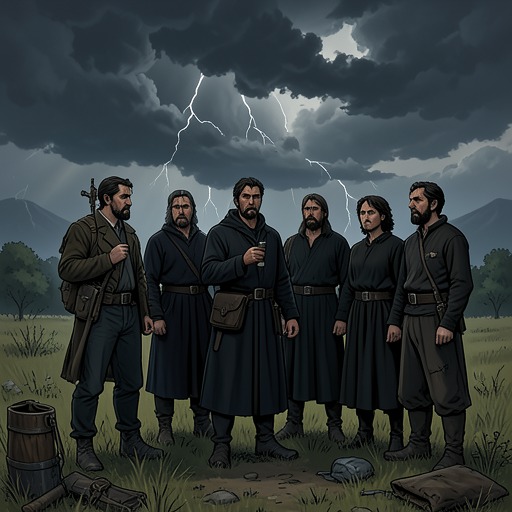
Leonard tells the family that the four visitors have come to prevent the apocalypse, and that the people inside the cabin can stop it only with the family’s help. He then makes the condition explicit: Andrew, Eric, and Wen must willingly choose one of their three to sacrifice and carry out the killing. If they refuse to choose or fail to follow through, he says, the rest of humanity—more than seven billion people—will perish. The family itself will survive, but, in Leonard’s account, only to witness the destruction and remain alone in the aftermath.
The tone of his explanation shifts. At first he speaks in a flat, almost administrative manner; as he describes the consequences, he becomes an impassioned advocate for the demand. Andrew is terrified and struggles to take in the scale of what Leonard is proposing. Leonard’s orderly presentation does not make the choice more comprehensible: it sets the family’s love for one another against a threatened catastrophe whose reality they cannot independently verify.
Leonard says he initially tried to ignore the message he had received, but came to believe that the events would happen regardless of his wishes or sense of fairness. When asked who is making him do this, he names God. Saying the name brings him both relief and fear. His account therefore combines certainty about the command with signs of personal unease; he identifies a divine authority, but does not speak as someone untouched by the terror of carrying out its instruction.
Visions, Repetition, and Belief
Leonard explains that he, Sabrina, and Adriane had visions of the lake and the small red cabin. His own vision included the dirt road and the cabin’s front door in unusually specific detail. He says he knew a family would be there and that the family would have to make a sacrifice. To him, the convergence of those images confirms that the family’s situation is a test, and that the visitors as well as the family have been chosen for it. He insists that the suffering will not last forever, while warning that failure will end the world.
The demand returns after the family rejects it. Leonard says they will be given the same choice again, calls the choice a gift, and frames sacrifice as an act that could save the world. He sets a deadline for the following morning and says the visitors will otherwise leave the family to reflect and talk. He repeats this statement word for word and with the same inflection. The precise recurrence makes the offer feel less like a developing conversation than a fixed pronouncement; the language of choice and generosity is repeated even though the family has already refused.
When the visitors assemble to present the choice again, Leonard acknowledges that he did not explain it well the previous day. He looks at his watch and avoids looking at Wen, then tells Adriane she will do well. The moment suggests discomfort with his own performance, but he does not withdraw the demand. The others take up the same weaponized wooden staffs they used before, and the family is once again made to confront the choice Leonard has described as voluntary.
Crisis and Changing Conduct
Leonard’s confidence is shaken when Andrew challenges the visitors’ account of Redmond. Leonard says that he, Sabrina, and Adriane also saw the cabin, and asks whether Andrew and Eric saw it too. He returns to the visions as evidence that the family has been selected for a test, but tries to qualify his certainty about Redmond’s identity. He acknowledges Andrew’s claim that thirteen years have passed and that Redmond is now substantially heavier. Leonard’s effort to reconcile the accusation with the group’s story shows that he is not simply repeating a settled account; he can register a contradiction, even as he continues to defend the larger mandate.
During the struggle between Andrew and Leonard over Andrew’s gun, Leonard initially senses Andrew weakening and prepares to accept his surrender without punishment. The struggle changes abruptly when Andrew pulls Leonard off balance. Leonard reacts in anger, and the gun discharges while their hands are entangled. Wen is struck and dies. Leonard’s role in the tragedy is neither that of a detached observer nor that of a deliberate shooter: he is physically involved in the struggle, and the shot occurs as he and Andrew grapple over the weapon.
After Wen’s death, Leonard asks Andrew and Eric to turn on the television. He recalls that after Redmond died, the visitors watched coverage of cities flooding, which he had said would happen. Now he wants to see whether Adriane’s death—or, more urgently, Wen’s—has stopped the next disaster. He cannot complete the thought. His appeal makes the supernatural test newly dependent on visible consequences, but the family does not ask him to explain further; they remain with Wen and prepare to leave.
Final Reversal and Narrative Role
As Andrew and Eric try to get out, Leonard asks them to wait and explains that Redmond’s truck is three miles from the cabin. He gives a detailed description of where its keys were hidden: beneath a flat, slate-colored rock with lichen, set back from the road near a tree with a large knot. He apologizes and says he will go with them because the location may be difficult to find. This is a practical offer that contradicts his earlier insistence that the family must remain inside the terms of the visitors’ test.
The reversal does not settle whether Leonard has freely changed his mind. He again says the family must choose soon, and the narrative describes a renewed compulsion within Sabrina as she responds. She takes up her staff and kills him. The contrast is stark: Leonard has just given the family information that could help them escape, yet he does not survive to accompany them. His death interrupts both the mission he had enforced and the assistance he had begun to offer.
Afterward, Sabrina retrieves Leonard’s white mesh mask and uses it to cover his face. Andrew then has her check O’Bannon’s pockets for the keys, still hoping they might be there and that the visitors’ account has been false. Leonard’s final practical information has not resolved the family’s fear or Andrew’s distrust. Across his arc, he functions as both the human voice of the sacrificial command and evidence of its instability: he urges an unbearable choice as divine necessity, struggles within the violence that follows, and turns toward helping the family only at the threshold of his own death.